How many RIAs run private credit strategies?
By Sean Douglas, founder of AdvPulse
Someone who sells to investment advisers asks a question like this every week. A fund administrator sizing a market asks it, and so does a placement agent building a list or a lender's business development team deciding who to call. The question sounds like a lookup: how many registered investment advisers run private credit strategies?
It is not a lookup, and this piece is about why. I take one question, run it against the public filings three ways, label what comes back by hand, and show in the figures where the difficulty sits. None of the procedures below is secret. The values we settle on for our own corpus are our work, and those are not here.
The data
An adviser's Form ADV has two halves. Part 1A is structured: boxes and numbers about clients, assets, employees and each private fund the adviser manages. Part 2A, the brochure, is prose: the firm describing its business, its methods of analysis and its strategies in its own words, for a regulator.
| Where the answer could live | What it records | Does it say "private credit"? |
|---|---|---|
| Part 1A, Item 5 | Client types, assets under management, employees, compensation | No |
| Part 1A, Schedule D, Section 7.B.(1) | Each private fund, with its type: hedge fund, liquidity fund, private equity fund, real estate fund, securitized asset fund, venture capital fund, other private fund | No. The nearest box is "other private fund" |
| Part 2A, Item 8 | Methods of analysis, investment strategies and risk of loss, in prose | Sometimes, in whatever words the firm chose |
The structured half has no box for private credit. The phrase lives in the brochure, if it lives anywhere.
So the count is a claim about meaning. Across the 21,550 advisers in the July 2026 SEC filings, the brochures on file run to hundreds of thousands of pages of prose written by thousands of different compliance teams, and the question has to be answered inside them.
Three phrasings, thirty passages
The public brochure search on advpulse.ai takes a phrase and returns the ten passages closest to it in meaning, with a similarity score between 0 and 1 for each. I ran the question three ways.
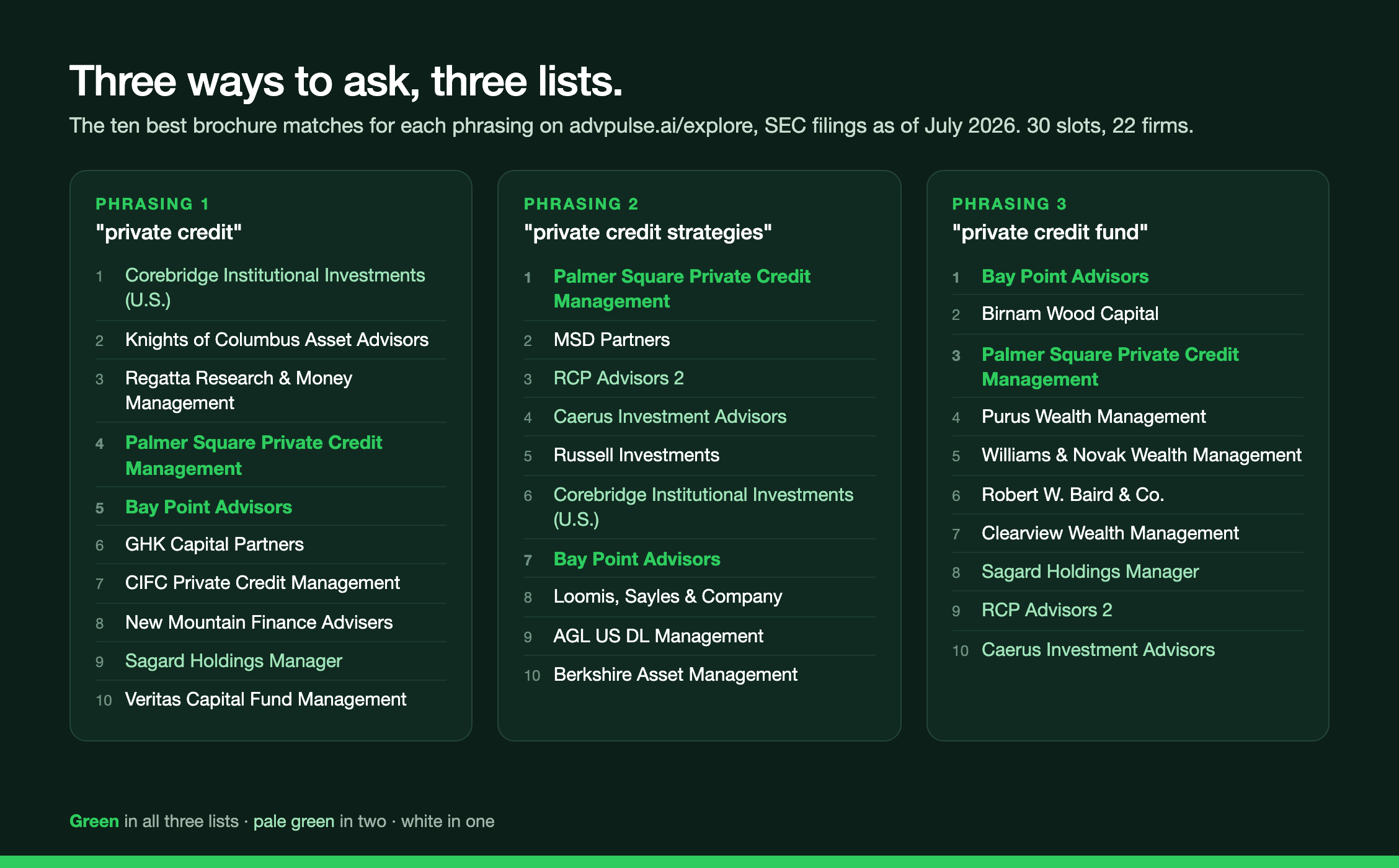
The ten best matches for each phrasing, SEC filings as of July 2026. Green firms appear in all three lists, pale green in two.
| Phrasing | 1st score | 5th | 10th | Firms also in another list |
|---|---|---|---|---|
| "private credit" | 0.738 | 0.726 | 0.708 | 4 of 10 |
| "private credit strategies" | 0.766 | 0.746 | 0.736 | 5 of 10 |
| "private credit fund" | 0.802 | 0.766 | 0.745 | 5 of 10 |
Thirty slots, twenty-two distinct firms. Two firms, Palmer Square Private Credit Management and Bay Point Advisors, appear in all three lists.
Two things in that table matter. The lists barely overlap: adding one word to the phrase replaces seven of the ten. And the scores of different phrasings are not on the same footing: the tenth match for "private credit fund" scored higher than the first match for "private credit". Palmer Square is first in one list, third in another and fourth in the third, on two different passages of the same brochure. The score orders passages by how close they sit to the words you typed. It does not know what you meant by them.
Reading the thirty
The next step is the one a machine cannot do for you. I read all thirty passages and labelled each one. Four kinds were enough.
Runs the strategy. Palmer Square Private Credit Management describes the strategies of its private credit fund. AGL US DL Management describes portfolios of directly originated, floating-rate senior loans. MSD Partners lists a Private Credit Opportunity strategy beside its others. Corebridge Institutional Investments' passage calls its Private Credit unit "a fundamentals-based underwriter of illiquid credit instruments." Sagard, RCP Advisors, Loomis Sayles and Bay Point each describe something of that kind; New Mountain's passage is about the information a Private Credit Client gives its investors; Veritas Capital's passage is the risk disclosure of lending to medium-sized private companies; CIFC Private Credit Management has it in its name. Even inside this kind, "runs" covers a firm whose whole business is private credit, a firm with one such strategy among a dozen, and a firm with a product unit that offers it to separate-account clients.
Allocates or offers it. Regatta Research & Money Management's brochure lists "key potential benefits of private credit for investors," which is an adviser explaining an asset class to its clients. Robert W. Baird's passage describes "Private Debt Funds (or Private Credit Funds)" as a product on its shelf. Russell Investments describes gaining exposure to alternatives through funds. Caerus Investment Advisors lists private funds among the strategies it uses for client accounts. In each of these passages the adviser is on the buying side. For a seller of fund administration they are the wrong list; for a seller of a private credit fund they are the right one.
For a seller of fund administration they are the wrong list; for a seller of a private credit fund they are the right one.
Boilerplate. Birnam Wood Capital, Purus Wealth Management and Williams & Novak Wealth Management carry the same two sentences, word for word: a private fund "is an investment vehicle that pools capital from a number of investors and invests in securities and other instruments." Clearview Wealth Management's version differs by a phrase. The passage says nothing about private credit. It is close in meaning to "private credit fund" because it defines the words "private" and "fund."
Near miss. Knights of Columbus Asset Advisors' passage is a clause about side letters in a commingled fund. Berkshire Asset Management's is about an intermediate credit bond strategy benchmarked to a Barclays index. GHK Capital Partners' is a generic risk paragraph about private funds. The words "private", "fund", "credit" and "strategy" are scattered across the three, and private credit is in none of them.
| Kind of passage | "private credit" | "private credit strategies" | "private credit fund" | Slots | Distinct firms |
|---|---|---|---|---|---|
| Runs the strategy | 7 | 7 | 4 | 18 | 11 |
| Allocates or offers it | 1 | 2 | 2 | 5 | 4 |
| Boilerplate | 0 | 0 | 4 | 4 | 4 |
| Near miss | 2 | 1 | 0 | 3 | 3 |
| All | 10 | 10 | 10 | 30 | 22 |
The thirty passages by kind. Add the word "fund" and the boilerplate arrives, four of ten.
None of this is a defect in the brochures. Each firm wrote what it does, as the form asks. The problem is that the question has at least three meanings, a buyer means exactly one of them, and nothing in the text says which.
What the score knows
The search behind those lists works on meaning rather than keywords. Every passage of every brochure is turned into a point in a space with many dimensions, placed so that passages that mean similar things sit near each other. The phrase you type becomes a point in the same space, and the search returns the passages nearest to it. "Near" is the score.
Here is the third list again, with the labels beside the scores.
| "private credit fund" | Score | Kind |
|---|---|---|
| Bay Point Advisors | 0.802 | Runs the strategy |
| Birnam Wood Capital | 0.777 | Boilerplate |
| Palmer Square Private Credit Management | 0.776 | Runs the strategy |
| Purus Wealth Management | 0.772 | Boilerplate |
| Williams & Novak Wealth Management | 0.766 | Boilerplate |
| Robert W. Baird & Co. | 0.756 | Allocates or offers it |
| Clearview Wealth Management | 0.755 | Boilerplate |
| Sagard Holdings Manager | 0.747 | Runs the strategy |
| RCP Advisors 2 | 0.747 | Runs the strategy |
| Caerus Investment Advisors | 0.745 | Allocates or offers it |
In this list the four boilerplate passages average 0.767 and the four firms that run the strategy average 0.768. The score does not separate them.
The score measures how much a passage resembles the phrase, and a paragraph that defines "private fund" resembles "private credit fund" a great deal. The line between "counts" and "does not" is not in the data; somebody has to draw it.
Where would a line go?
Suppose you tried to draw it on this score alone. Take the twenty-two firms, each at its best score across the three phrasings, and keep everything above a cutoff.
| Cutoff | Firms kept | Run the strategy | Allocate or offer | Boilerplate | Near miss | Runners lost |
|---|---|---|---|---|---|---|
| 0.77 | 4 | 2 | 0 | 2 | 0 | 9 of 11 |
| 0.75 | 8 | 3 | 1 | 4 | 0 | 8 of 11 |
| 0.74 | 13 | 6 | 3 | 4 | 0 | 5 of 11 |
| 0.73 | 18 | 8 | 4 | 4 | 2 | 3 of 11 |
| 0.70 | 22 | 11 | 4 | 4 | 3 | 0 of 11 |
Every cutoff that keeps the boilerplate out also drops most of the firms that run the strategy; every cutoff that keeps the runners also keeps the boilerplate.
There is no row in that table a buyer would accept. At 0.75 you keep all four boilerplate passages and three of the eleven runners. At 0.73 you have most of the runners and everything else besides. The raw similarity of one phrasing is a retrieval tool, good for putting thirty passages worth reading in front of a reader, and not a classifier.
That is the whole difficulty, and it is a data-science problem before it is an engineering one. Where the line belongs depends on the question, because the passages that mean "runs private credit" are not at a fixed distance from the passages that mean "explains private credit to clients." It depends on the corpus. Brochures are a dialect of their own, written for a regulator by compliance officers, with their own boilerplate and habits; a line that works for brochures is wrong for news articles, and a line that works for private credit is wrong for tax-loss harvesting or interval funds. There is no setting that solves this once for all text everywhere. There are procedures, and they have to be run for every corpus and every question.
The procedures
There are four, and none of them is a setting.
First, the labelled sample. What I did above with thirty passages is done with a few hundred, by a person who reads brochures for a living, and the labels are kept. That sample is the only ground truth there is. A machine cannot decide that a product shelf's "or Private Credit Funds" is a different fact from a fund manager's "private credit investment strategies." A person can, in seconds, and the labels record it.
Second, the line per question. Lay the labelled passages out and you can see where the meaning changes and how sharp the change is. For some questions it is a clean break. For private credit, as the tables show, it is a wide band where the runners, the allocators and the boilerplate overlap, and the line has to be drawn with more than one phrasing's raw score in hand. It is recorded with the question, not reused for the next one.
A line drawn in July is a hypothesis about the filings in October.
Third, re-measurement. Advisers amend their brochures at least once a year, firms register and deregister every week, and the vocabulary is not fixed. The same strategy is "private debt" in one brochure and "private credit" in another, which is what Baird's parenthetical records. A line drawn in July is a hypothesis about the filings in October. Every re-measurement is a chance to find that the line has moved.
Fourth, the space itself. The geometry that places the passages decides what "near" can mean at all. Whether a space built for general English knows that in this corpus "private fund" is boilerplate and "directly originated senior loans" is a strategy is a question you test, not one you assume.
Each of these is specific to the text it runs on and the question it serves, and each has to be designed by someone who can read a distribution and read a brochure. The engineering is what makes them cheap enough to run again and again.
Why nobody has done this for the ADVs
Doing the procedure once, for one question, is an afternoon with a sample and a spreadsheet. Doing it for every question a seller might ask means placing every passage of every brochure in the space ahead of time, so a question can be measured against all of it in seconds instead of hours. It means connecting each passage back to the structured half of the filing, so that "runs private credit strategies, advises individuals, and manages more than a billion dollars" is one question instead of three lookups and a merge. And it means rerunning all of that as filings arrive, because a brochure amended on Tuesday is not in Monday's index.
That is a lot of logic and a lot of computation for a dataset most people treat as a lookup table. It is why most datasets never get this treatment, and why I have not found a data product that gives it to the ADVs. That work is where the moat is, because the result is a corpus you can ask questions of in plain language and get an answer whose definition you can inspect.
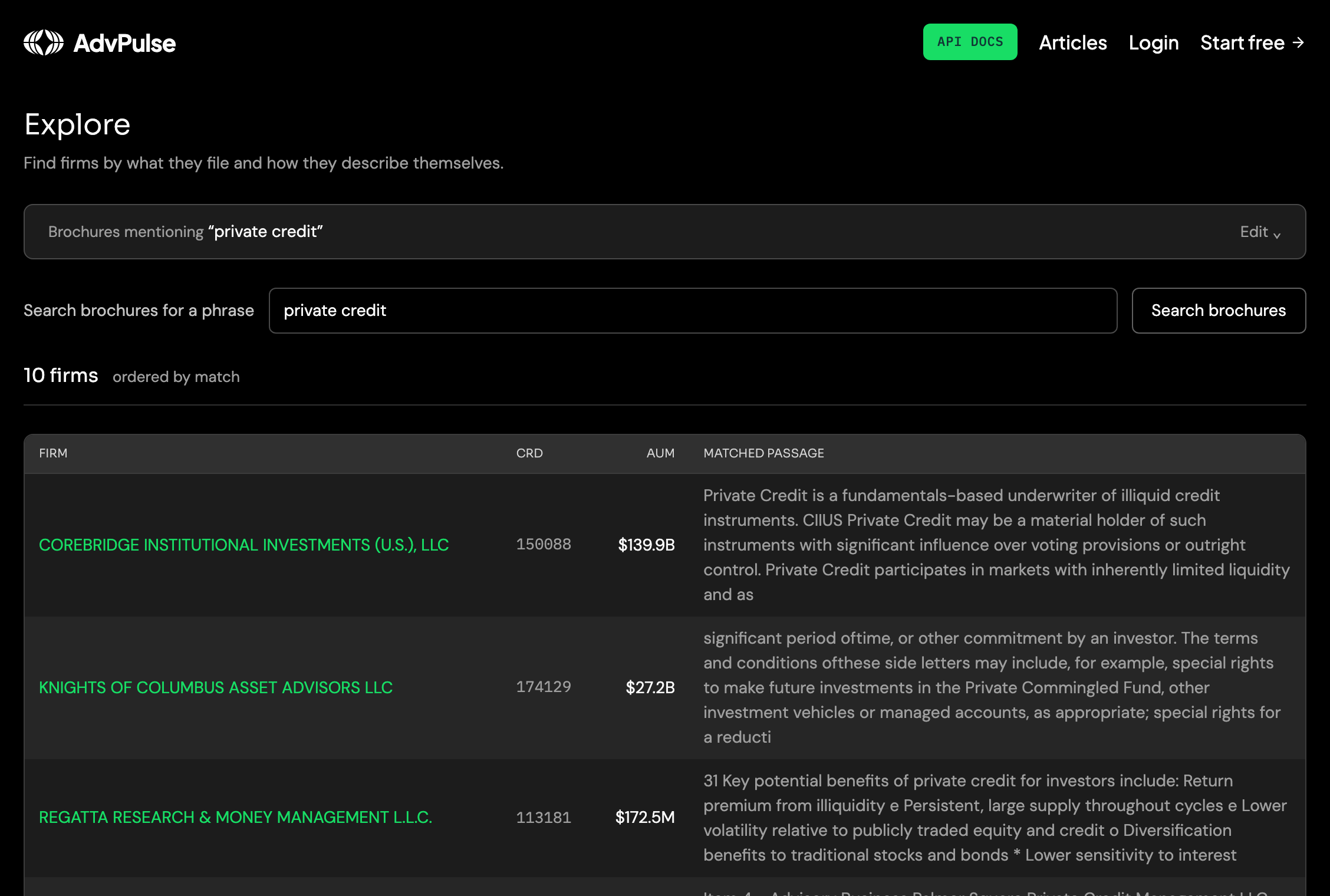
The public brochure search set to "private credit", with the passage each firm matched on beside it.
The count is the output of a procedure that somebody designed for this corpus and this question, and keeps measuring. There is no error bar to put on "private credit," only a definition, chosen for the question and tested against the text. If you want to see the raw material, the brochure search at advpulse.ai/explore takes a phrase and shows you the passages, no account needed.