Three deep questions, checked firm by firm
By Sean Douglas, founder of AdvPulse
This piece is about hard questions: ones whose answer sits in a firm's Form ADV data, down to its individual private funds, read together with what its brochure says. Questions like these are where a seller's best-fit list comes from, and they are the questions we built AdvPulse to answer.
We put five questions of that kind to two systems, each in the same words. One was AdvPulse, the deep research tool we built to find the advisory firms and people a given product fits. The other was a leading general-purpose AI assistant with web search. Three of the five are shown here, picked after the results were in.
The three questions
- Advisers with at least one private fund under $250 million that is unaudited or carries an audit opinion that is not clean, with the chief financial officer or chief compliance officer to contact.
- The first question narrowed, asked as a seller of fund administration and audit-readiness services: only real-estate or private-equity funds, at firms that also advise individuals and whose brochure discloses performance fees or carried interest from those funds, with the CFO or CCO and one more decision-maker, why the firm fits and how to open the conversation.
- Asked as a seller of real-estate co-investments: wealth managers that sponsor their own real-estate fund, or a feeder into another manager's, with more than 25 investors and a minimum under $250,000, whose brochure discloses the conflict in recommending it, with the person who runs investments and one more decision-maker, why the firm fits and how to open the conversation.
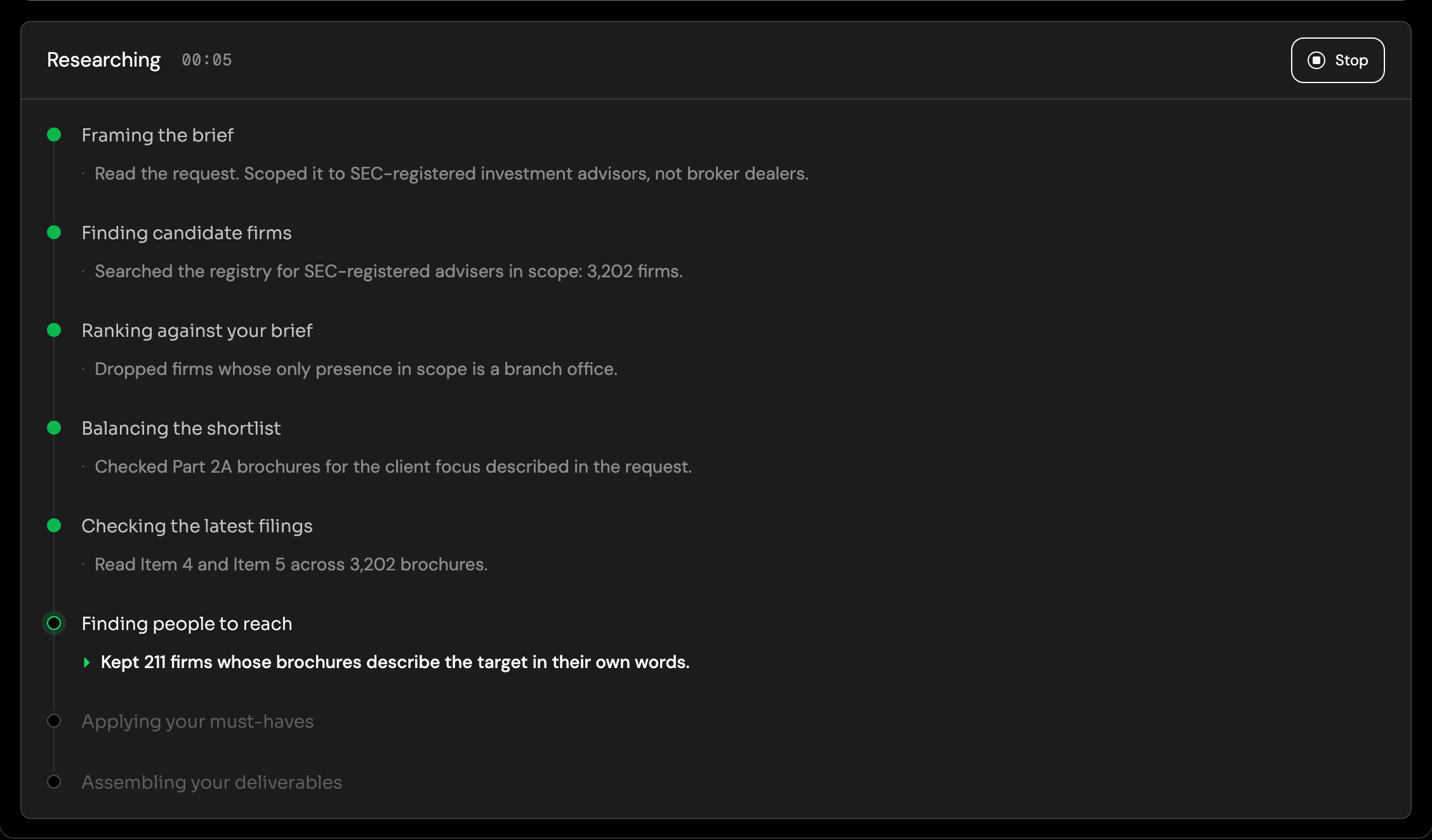
A Deep Research run works through a question in steps, from the register to the brochures to the people. Shown on invented example data.
How we counted
Each system had one run per question: one conversation, the first pass a user makes on a deep question to see whether the results are worth going further with. AdvPulse ran in an internal mode on our own development setup, its lists planned at twelve firms a question. The assistant could search the web and open pages.
We then checked every firm either system returned against its current Form ADV and brochure, on 4 and 5 October 2026. A firm counts only where every condition in the question was confirmed there and the firm was SEC-registered on the day of the check. A person counts only at such a firm, confirmed on Schedule A of its Form ADV, the SEC's roster or the firm's own site, with an email on the firm's domain. A result is ready to act on when it has all four: a verified firm, a reason it fits, an outreach angle, and a confirmed person to write to.
What came back
| Across the three questions | The assistant | AdvPulse |
|---|---|---|
| Of the results meeting every condition, ready to act on | 1 of 5 | 25 of 28 |
| People to reach at those firms, with an email on the firm's own domain | 1 | 47 |
| Firms meeting every condition | 5 | 26 |
Ready counts are over the results that met every condition, not over everything returned (36 by AdvPulse, 7 by the assistant). The 28 are 26 distinct firms, two qualifying on both of the first two questions; the 50 person rows are 47 people.
- Small private funds without a clean audit. The assistant returned no list and said why: "I could not produce this list: the screen needs the SEC's Form ADV fund-level data, and every source of it came back unreadable". Ten of AdvPulse's twelve firms met every condition, nine of them ready to act on, with 18 people to reach.
- The narrower version, real estate and private equity. The assistant returned two firms and both met every condition; it named people confirmed at each, but gave only the firm's main line, no email. Ten of AdvPulse's twelve met every condition, nine ready to act on, with 18 people.
- Wealth managers with their own real-estate funds. Three of the assistant's five firms met every condition, one ready to act on, with one person to reach. Eight of AdvPulse's twelve did, seven ready to act on, with 14 people.
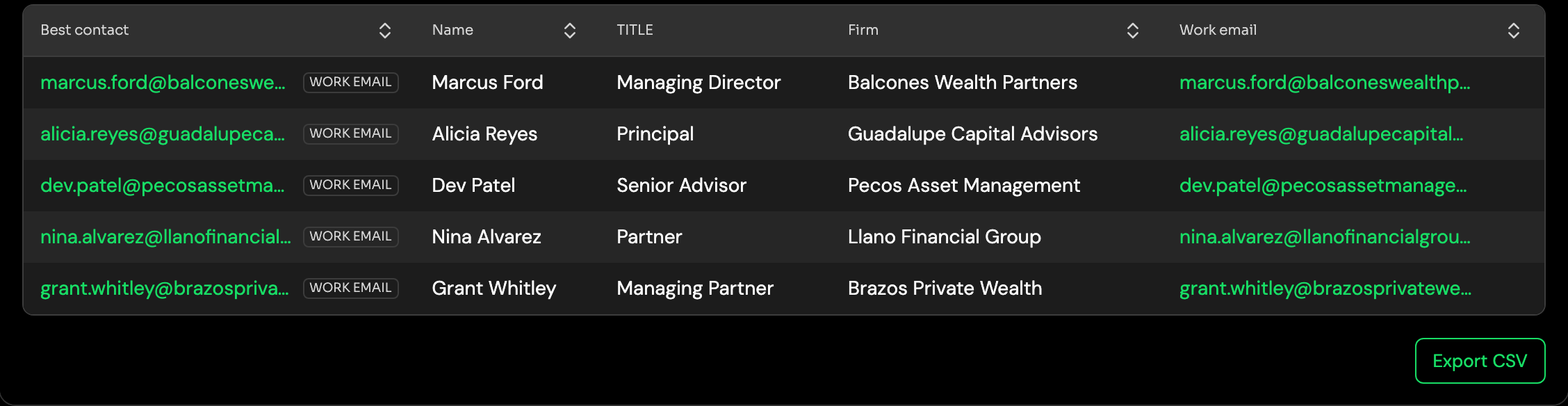
Each result ends with the people to write to and how to reach them. Shown on invented example data.
The counts are what one conversation returns, not how many firms exist. AdvPulse's run plans twelve firms a question at its default setting, a first pass sized so that a user can read the results and go further where they are good; spend an afternoon with the assistant and you will find more than it did here. The comparison is what a first pass returns, one conversation each, and that was 47 people to write to against 1.
On these three questions, the assistant sampled and AdvPulse screened the register.
What the runs taught us
We run experiments like this on questions a seller would ask, and they find holes in our own pipeline as often as they show something against a frontier model. This round found three, each one a job for the pipeline:
- Two firms on the first question were marked verified on the day of the run but had left SEC registration one and two weeks earlier; both are out of every count here. The register moves all the time, and a verification is only as fresh as its last read.
- One email on the second question was on a domain with no website and no mail records, also out.
- A few fit reasons at firms that still count carried a mistake inside them: a fund count read from a superseded filing, a quoted sentence that is not in the current brochure.
The assistant also found three firms across these questions that met every condition and that our lists lacked: our screen was too narrow there. That is how the pipeline gets built: a question a seller asks, a check against the public record, a fix in the data layer, and the next question.
Why this takes a pipeline
On these three questions, the assistant sampled and AdvPulse screened the register. The difference is not which model is smarter. A frontier model with web search is a remarkable reader, and on simple questions both systems pass. On a question like the first one it has to find the SEC's fund-level data, read it for every firm, join it to each brochure, confirm the people and resolve their emails, all inside one conversation, and it could not get past the first step.
Making that data usable is an engineering job, not a prompt. It means an ETL system and a data pipeline over the whole register, with the financial-services judgement built in: what counts as a private fund under $250 million, which audit opinions are not clean, how a brochure discloses a conflict, which person at the firm is the one to write to. This is judgement-heavy, consequential work. No one would sign off on an agent inventing its own data pipeline as it reads, one result at a time, and a frontier model is not going to replace the work of building one. The adviser lists that sales teams subscribe to are not built for it either: a list tells you who is there, not who fits or why.
That is the choice we made as a company. For a best-fit analysis that involves financial-services expertise and the qualification of every lead, making the public data usable takes a lot of engineering, and that is what we have chosen to do.
A list tells you who is there, not who fits or why.
What we take from it
In one conversation each, AdvPulse found five times the firms that met every condition, and 25 of those 28 results carried the research behind the firm: why it fits, an angle to open with, and a confirmed person to write to. The holes the runs found go back to the pipeline as work, and the next round of questions will find the next ones.
Deep research is live for every AdvPulse customer today. If you have a question that needs this depth, start free at advpulse.ai. To look first, the public search at advpulse.ai/explore lets you search advisers' brochures and open a firm's record, no account needed.